Explore benchmark OEM/ODM ophthalmic platforms and smart frame assemblies specified for international optical distributors and retail chains.

The global vision care market is experiencing a structural shift. Historically categorized strictly as a corrective medical accessory, the modern prescription lens has evolved into a high-technology optical substrate. Modern B2B optical buyers—ranging from multinational hospital supply chains and retail optical conglomerates to direct-to-consumer eyewear disruptors—no longer evaluate a prescription lenses factory purely on cost-per-unit metrics. Today, evaluation hinges on substrate purity, chromatic aberration indices (Abbe value balance), digital free-form surface accuracy, advanced thin-film coating durability, and seamless compatibility with active micro-electronics.
As smart glasses transition from early-adopter novelties into mainstream daily accessories, leading prescription lenses suppliers are integrating specialized edging geometries, clip-on carriers, photochromic matrix formulations, and electrochromic layer stacks directly into their production lines. Factories that maintain high-yield production across high-refractive indices (such as 1.60, 1.67, and 1.74 ultra-thin resin formulations) while mastering micro-display and open-ear acoustic structural integrations are establishing decisive competitive advantages.
SEO Search Intent Insight & Information Gain: When sourcing top prescription lens factories, B2B procurement officers search for verification of optical tolerances (ANSI Z80.1 standard), free-form surfacing capabilities, hydrophobic coating longevity, and automated Rx edging integration. This whitepaper analyzes the technical parameters governing global supply chain decisions in 2026.
To successfully navigate supplier selection, enterprise buyers must assess both traditional lens manufacturing engineering (grinding, polishing, AR coating, hard-coat dip tank consistency) and modern modular integration capabilities (such as SmartHinge™ frame swap compatibility, magnetic Rx inserts, and thin-film sensor embedment).
To establish a resilient supply chain, optical buyers must evaluate manufacturers across five critical engineering pillars. Below is a detailed breakdown of technical standards expected from top-tier ophthalmic lens manufacturers:
From standard CR-39 (1.498) to high-index MR-8 (1.60), MR-7 (1.67), and ultra-thin 1.74 resin. Premium suppliers control monomer purity to prevent yellowing and maximize impact resistance via Polycarbonate and Trivex materials.
Computer-controlled diamond-point turning yields sub-micron precision for progressive addition lenses (PAL). This drastically reduces peripheral distortion and maximizes visual fields for complex astigmatic prescriptions.
Multi-layer Anti-Reflective (AR) optical stacks combined with super-hydrophobic, oleophobic, and anti-static top coats. Advanced factories utilize physical vapor deposition (PVD) chambers for maximum coating adhesion.
Fast-acting molecular spin-coating technologies that darken dynamically under solar UV radiation and return to complete clarity indoors within seconds, essential for versatile daily-wear frames.
Precision edging for open-ear smart frames (such as Solos AirGo™ and audio sunglasses), modular clip-on carriers, anti-blue light filtering for digital display use, and electrochromic tint adjustment integration.
Automated lensometer inspections checking power deviation, cylinder axis accuracy, optical center positioning, and cosmetic defect screening under class 10,000 cleanroom environments.
Understanding substrate characteristics allows optical buyers to select the optimal material balance based on wearers' prescription strength and lifestyle demands:
| Substrate Material | Refractive Index ($n_d$) | Abbe Value ($V_d$) | Specific Gravity ($g/cm^3$) | UV Cut-Off (nm) | Recommended Rx Range |
|---|---|---|---|---|---|
| Standard Resin (CR-39) | 1.498 | 58 | 1.32 | 350 - 380 | Low Plano to ±2.00 D |
| Polycarbonate | 1.586 | 30 | 1.20 | 385 | Active / Kids (±4.00 D) |
| Mid-Index (MR-8) | 1.600 | 42 | 1.30 | 400 | Moderate (±2.00 to ±5.00 D) |
| High Index (MR-7) | 1.670 | 31 | 1.35 | 400 | High (±5.00 to ±8.00 D) |
| Ultra-High Index | 1.740 | 33 | 1.47 | 400 | Extreme (> ±8.00 D) |
| Trivex | 1.530 | 45 | 1.11 | 400 | Rimless & Impact Resistance |
As the optical industry matures, the traditional boundary between prescription eyewear manufacturers and technology companies has dissolved. Enterprise procurement directors must prepare for three major market trajectories reshaping prescription lens manufacturing:
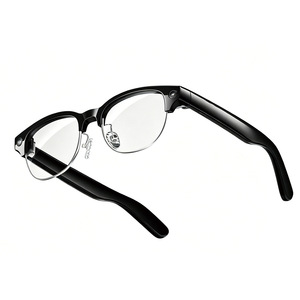
Consumer reluctance to purchase single-purpose smart eyewear has been overcome by modular frame architectures. Systems utilizing SmartHinge™ frame swap mechanics allow users to detach the electronic temples housing audio micro-drivers, Bluetooth chipsets, and beam-forming microphone arrays, and attach them across multiple prescription frame fronts (such as optical clear glasses, polarised sunglasses, or photochromic sports frames). Factory suppliers capable of producing standardized frame front geometry with pre-glazed prescription lenses are capturing significant market share.
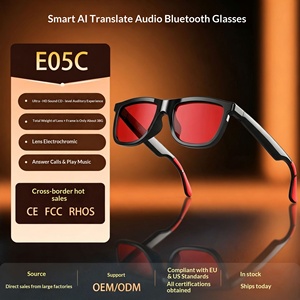
Static sunglasses tints are increasingly supplemented by electrochromic (EC) smart tinting. As demonstrated in models like the E05C Four-Gear Touch Color Changing Smart Glasses, liquid crystal or electrochromic films are laminated inside prescription lens blanks. With touch-control inputs on the frame temple, wearers can manually adjust tint density across four distinct light transmission levels. Furthermore, precision optical factories are now mastering micro-groove edging to host waveguide optics and micro-displays without compromising the structural integrity or refractive power of custom prescription lenses.
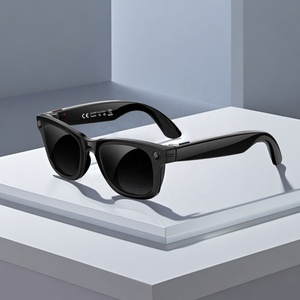
Smart audio glasses rely on precise acoustic beam-steering to project audio into the ear canal while suppressing ambient sound leakage. Modern prescription lens surfacing must consider the acoustic cavity profile of the frame front. Lens edge thickness and bevel placement directly impact temple fit and speaker alignment. Leading OEM/ODM factories utilize 3D digital tracing to ensure that custom-glazed high-index lenses maintain perfect frame alignment, preserving IP54 water-resistance seals and acoustic channel geometry.
Grounded in decades of micro-display innovation and optical physics engineering derived from pioneering technology initiatives through Kopin Corporation, our manufacturing partner network represents the pinnacle of ophthalmic and smart eyewear production.
Unlike standard white-label optical assembly workshops, our global manufacturing ecosystem operates under rigorous ISO-controlled protocols, backed by an extensive intellectual property portfolio spanning over 100 patents and patent applications. Our specialized facilities seamlessly integrate lens surfacing, coating, micro-electronics integration, and Rx edging under one roof.
Protected mechanics including SmartHinge™ frame swapping, Whisper® audio noise cancellation technology, and advanced optical display mounting structures.
End-to-end custom frame development, custom lens index casting, specialized optical coatings, private-label branding, and packaging customization.
Firmware support for SolosChat™ AI assistant, SolosTranslate™ real-time multi-language voice translation, and custom developer SDK interfaces.
Below are authoritative responses to the most critical technical and operational questions asked by optical buyers during factory audit and supplier onboarding procedures.
Our partner manufacturing lines adhere strictly to international ophthalmic standards including ANSI Z80.1, ISO 21987, and EN ISO 14889. Sphere power tolerances are maintained within ±0.06 D for low power and ±0.12 D for high prescriptions. Cylinder axis alignment is calibrated to within ±1 degree on automated digital lensometers.
All lens blanks undergo multi-stage ultrasonic cleaning in deionized water tanks before entering high-vacuum Ion-Assisted Deposition (IAD) coaters. Coating stacks undergo rigorous thermal shock testing (-20°C to +60°C), cross-hatch tape adhesion tests, and automated bayonet abrasion testing to guarantee long-term durability against peeling or crazing.
Yes. Our facilities specialize in precision beveling, step-cut edging, and custom rimless notch cutting required for smart frames. We provide customized prescription lens inserts, clip-on optical carriers, and direct-frame glazed solutions that maintain full functionality of on-board camera sensors, touch panels, and IP54 weather seals.
We offer both mass-tinting (in-monomer) photochromic blanks and high-speed molecular spin-coating options. Spin-coated photochromics provide faster response times (activating under UV in under 15 seconds and clearing in 60-90 seconds) and ensure uniform darkness depth across non-uniform lens thicknesses in high-diopter prescriptions.
Standard wholesale stock lens orders carry flexible low MOQs starting at 100 pairs per index/coating tier. For fully customized OEM smart glasses frame designs, custom color injection moulding, or proprietary optical coating formulations, standard production batch MOQs start at 500 to 1,000 units depending on customization complexity.
100% of finished lenses undergo automated optical mapping for surface aberrations, focal length validation, and cosmetic defect inspection under high-intensity polarized lighting. Smart eyewear assemblies undergo automated battery cycle testing, Bluetooth RF attenuation verification, microphone noise-floor calibration, and IP54 splash-chamber testing.
Whether expanding your retail product line with high-index digital progressive lenses, introducing light-adaptive photochromic collections, or launching next-generation AI smart audio glasses, our engineering infrastructure provides the speed, precision, and intellectual property backing your enterprise demands.